Imagine this. It is late at night. Your father is struggling to breathe. You know he needs oxygen, but you do not know what the right oxygen cylinder for home use is.
Choosing the right one can feel confusing during an urgent need, because there are different cylinder sizes and capacities. And the wrong one may make home oxygen use less convenient and may cause unnecessary stress.
The good news is that you can avoid the mistake and ensure peace of mind. In this guide, I will walk you through everything step by step. By the end, you will know exactly what to pick.
👉 Note: Oxygen is a medical treatment. Always follow your doctor's advice on how much oxygen you need.
What Is an Oxygen Cylinder for Home Use?
An oxygen cylinder, or medical oxygen cylinder, is a strong metal tank that holds pure medical oxygen under high pressure. You attach a regulator to it. Then you breathe the oxygen through a mask or a thin tube called a nasal cannula.
People use oxygen cylinders at home for many reasons. Some need it every day. Others need it only during an emergency.
Why Choosing the Right Oxygen Cylinder Matters
Not every oxygen cylinder is suitable for every patient or situation.
For example, a small cylinder may be easier for you to move, but it may not last long if you need oxygen continuously. A larger cylinder can provide oxygen for a longer time, but it may be heavier and take up more space.
The right oxygen cylinder for home use should balance these things:
- The patient's oxygen need
- Required usage time
- Cylinder capacity
- Available space at home
- Portability
- Budget
- How easily you can replace or refill it
Get this right, and make oxygen support safer and less stressful for your patient and the family.
Who May Need Oxygen at Home?
Only a doctor can say if you need oxygen. Doctors often suggest it when blood oxygen stays too low. This can happen with:
- COPD (chronic lung disease)
- Severe asthma
- Lung infections like pneumonia
- Long-term effects of COVID-19
- Heart failure
- Pulmonary fibrosis
- Sleep-related breathing problems in some cases
👉 Note: Your doctor will tell you the flow rate. This is how much oxygen you get each minute. It is shown as liters per minute (LPM). You will need this number to choose the right cylinder.
Understand Oxygen Cylinder Sizes
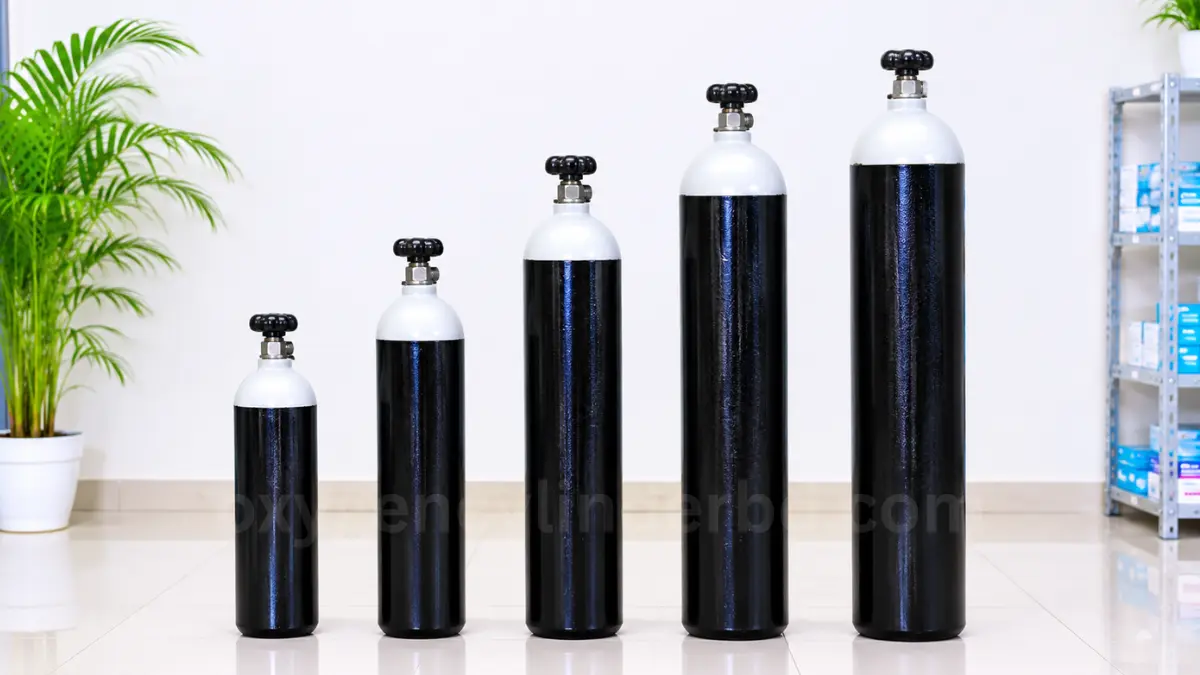
Cylinders come in many sizes. Sizes and names vary by country and supplier. The table below shows common sizes and approximate capacity.
| Size | Approx. Oxygen Capacity | Best For |
|---|---|---|
| Small portable (M6, M9) | About 150 to 250 liters | Short trips, walking, travel |
| D | About 400 liters | Light daily use, short backup |
| E | About 650 to 700 liters | Home backup, moderate use |
| M | About 3,000 liters | Longer home use |
| H or K (large) | About 6,000 to 7,000 liters | Long use, main supply at home |
Both small and large oxygen cylinders have their own advantages and disadvantages. Here is a quick side-by-side look at smaller and larger cylinders:
| Factor | Smaller Cylinder | Larger Cylinder |
|---|---|---|
| Portability | Easier to move | Harder to move |
| Oxygen storage | Lower capacity | Higher capacity |
| Usage time | Usually shorter | Usually longer |
| Space needed | Less | More |
| Weight | Lighter | Heavier |
| Best for | Short-term use or backup | Longer use at home |
Key Factors to Consider Before You Choose
Now let us look at what really matters. Go through these points one by one.
1. Your Prescribed Flow Rate
This is the most important point. A person using 2 LPM will use oxygen slowly. A person using 6 LPM will finish the same cylinder much faster. So always start with the number your doctor gave you. Do not guess. Do not change it on your own.
Before you shop, try to answer these questions:
- What flow rate has the doctor advised?
- How many hours a day is oxygen needed?
- Is it needed all the time or only at certain times?
- Is the need short-term or long-term?
- Will the patient stay mostly in one room, or move around?
👉 Note: Never guess the flow rate. Every patient is different, so do not copy another person’s setting.
2. How Long You Need the Oxygen to Last
Ask yourself:
- Will I use it all day or only a few hours?
- Is it just for emergencies?
- Do I need it at night?
- Will it be my only supply or a backup?
Your answers help you pick the size. Heavy daily use needs a larger cylinder or more than one.
When you talk to the supplier, share these details:
- The prescribed flow rate
- Expected hours of use each day
- Whether oxygen is needed continuously
- This helps them suggest a cylinder size that fits.
3. Where You Will Keep and Use It
Think about your home space. A big cylinder needs a safe corner. It must stand upright. It must be away from heat.
Also think about stairs. If you live on an upper floor, a heavy cylinder is hard to bring up. Smaller cylinders may be easier.
When you pick the spot, check for:
- Enough space around the equipment
- A stable position where the cylinder cannot be knocked over
- Easy access for the caregiver
- A convenient place for the patient
4. Weight and Ease of Moving
Can you or your family handle the weight? A full large cylinder can be very heavy. If the patient must move it alone, choose a lighter one. A wheeled cart can help a lot.
Portability matters more if:
- The patient moves between rooms
- The cylinder needs to be carried or transported
- You want a backup that is easy to move
- The patient needs oxygen while travelling, with medical approval
But do not choose a cylinder only because it is light. It must also hold enough oxygen for your needs.
5. Supply and Refill Access
This is often missed. A cylinder is only useful if you can refill it fast.
Before buying, check:
- Is there a trusted oxygen refill service provider near you?
- Do they refill at night or on holidays?
- Do they deliver to your home?
- How long does a refill take?
A good supplier is as important as a good cylinder.
Also ask the supplier:
- How do I request a replacement?
- How fast can one be arranged?
- Is emergency support available?
- Will you collect the empty cylinder?
- Which areas do you cover?
A smooth replacement process can take a lot of stress off the family.
6. Quality and Safety Certification
Only buy cylinders from a licensed, trusted oxygen cylinder seller. Look for:
- Proper medical-grade oxygen
- Clear labels and markings
- A valid test date on the cylinder
- No rust, dents, or damage
- A working valve
If anything looks off, do not take it.
Also check the rest of the setup before you accept it:
- The regulator works properly
- The pressure gauge is easy to read
- The flow meter works
- The tubing and mask or cannula are in good shape
- All connections are tight and secure
If you are renting, ask the supplier to explain the equipment before you start using it.
7. Your Budget
Cost has two parts. First is the cylinder and its accessories. Second is the cost of refills. You can rent oxygen cylinders instead of buying. Renting can cost less at first and may include servicing. Compare both options.
Do not look at the first price alone. Ask for the full cost, which may include:
- Cylinder rental or purchase price
- Delivery charges
- Accessories
- Refill or replacement costs
- Setup charges, if any
- Other service fees
👉 Note: The cheapest option is not always the best one. Good equipment and reliable service make a big difference.
How to Know How Long a Cylinder Will Last
This is the part that worries most people. But it is easier than it sounds.
Every cylinder has a pressure gauge on the regulator. It shows how full the cylinder is. Each cylinder size also has a number called a cylinder factor.
The formula is:
Duration (minutes) = (Gauge pressure in PSI × Cylinder factor) ÷ Flow rate in LPM
Here are common cylinder factors:
| Cylinder Size | Cylinder Factor |
|---|---|
| D | 0.16 |
| E | 0.28 |
| M | 1.56 |
| H | 3.14 |
Example: You have a full E cylinder at 2,000 PSI. Your flow rate is 2 LPM.
- 2,000 × 0.28 = 560
- 560 ÷ 2 = 280 minutes
- That is about 4 hours and 40 minutes.
Simple, right?
💡 Tip: Never run the cylinder to zero. Keep a safety margin. Plan to swap or refill when the gauge gets low. Also, factors can vary a little by brand, so ask your supplier to confirm.
Quick Duration Guide
Here is a rough idea for a full E cylinder at different flow rates:
| Flow Rate | Approx. Duration (Full E Cylinder) |
|---|---|
| 1 LPM | About 9 hours 20 minutes |
| 2 LPM | About 4 hours 40 minutes |
| 3 LPM | About 3 hours 10 minutes |
| 5 LPM | About 1 hour 50 minutes |
| 10 LPM | About 55 minutes |
👉 Note: These are estimates. Always check your own gauge.
Essential Accessories You Will Need
A cylinder alone is not enough. You need a few more items to use it safely.
- Regulator: Controls the pressure and flow. It usually has a gauge.
- Flow meter: Lets you set the exact liters per minute.
- Nasal cannula or mask: The part you breathe through. Your doctor will say which one.
- Humidifier bottle: Helps if oxygen feels dry. Some people need it, some do not.
- Cylinder trolley or stand: Keeps the cylinder upright and steady.
- Spare tubing: Tubes wear out. Keep extras.
- Cylinder key or wrench: Needed for some valves.
👉 Note: Make sure the regulator fits your cylinder’s valve type. Not all parts are compatible. Ask your supplier to check.
Oxygen Cylinder Safety Rules at Home
Oxygen helps fire burn faster. That is why safety matters so much. Follow these rules every day.
Do:
- Keep the cylinder upright and fixed in a stand or cart.
- Keep it at least 5 to 10 feet away from flames, stoves, and heaters.
- Store it in a cool, dry, well-ventilated place.
- Open the valve slowly.
- Keep spare cylinders secured too.
- Put “Oxygen in use” or “No smoking” signs near the area.
- Keep a fire extinguisher nearby.
Do not:
- Never smoke near oxygen. Never let anyone else smoke either.
- Never use candles, incense, or open flames nearby.
- Never use oil, grease, or petroleum jelly on the valve or regulator.
- Never use oil-based creams near your nose while on oxygen. Use water-based products.
- Never let the cylinder fall or roll.
- Never leave it in a hot car or in direct sun.
- Never try to repair a damaged cylinder yourself.
⚠️ Caution: If you smell gas or see damage, close the valve and call your supplier right away.
How to Store Your Cylinder Properly
Good storage keeps your family safe and your cylinder in good shape.
- Choose a spot away from heat and direct sunlight.
- Keep it away from electrical sockets and sparks.
- Use a chain, strap, or stand so it cannot tip over.
- Keep the valve cap on when not in use.
- Do not store it in a closed cupboard with no air.
- Keep it away from kids and pets.
How Many Cylinders Should You Keep?
This depends on your use. Here is a simple guide:
| Situation | Suggested Setup |
|---|---|
| Emergency use only | One medium cylinder, kept full |
| Daily use with a concentrator | One cylinder as power-cut backup |
| Daily use without a concentrator | At least two cylinders, so one is always full |
| Active person who goes out | One home cylinder plus one small portable |
💡 Tip: The golden rule is: Never wait until the last cylinder is empty. Always have one ready.
Have a Backup Plan
If the patient depends on oxygen, plan earlier. Know what you will do if:
- The cylinder is running low
- A replacement is delayed
- The equipment has a problem
- The patient seems to need more help than usual (call the doctor right away)
👉 Note: Keep the supplier’s phone number where everyone can see it. Keep your doctor’s number close too. Check the gauge as you were taught, and order a replacement early. Do not wait until the last minute.
Buy or Rent: Which Is Better?
Both options work. It depends on your needs.
Buying may suit you if:
- You will need oxygen for a long time.
- You have a reliable refill source nearby.
- You want full control over your equipment.
Renting may suit you if:
- You need oxygen for a short time, like after an illness.
- You want to avoid a high upfront cost.
- You want the supplier to handle checks and servicing.
💡 Tip: Ask about delivery, refill charges, deposits, and return rules before you decide.
Questions to Ask the Supplier Before Buying
A good oxygen cylinder supplier will answer all of these happily. Keep this list handy.
- Is the oxygen medical grade?
- What is the exact capacity of this cylinder?
- When was it last tested?
- Which regulator and flow meter fit it?
- Do you offer home delivery and refills?
- What are your refill timings?
- Can I get help in an emergency?
- Do you give a bill and warranty details?
- Can you show me how to use it safely?
Ask for Proper Setup and Instructions
If nobody at home has used an oxygen cylinder before, ask for a short demo. A trained person from the supplier should show you how it works. Do not be shy about asking questions. It is far better to learn now than during an emergency.
Make sure you understand:
- How to position the cylinder
- How to connect the regulator
- How to set the flow as prescribed
- How to read the pressure gauge
- How to connect the mask or nasal cannula
- What to do when the oxygen is running low
- Who to call if something goes wrong
➡️ Note: Make sure the caregiver knows these basics too, not just the patient.
Common Mistakes to Avoid
Many people make the same errors. Here is how to skip them.
- Buying the cheapest option without checking quality. Safety comes first.
- Choosing a size that is too small. You will run out too fast.
- Ignoring the flow rate. This leads to the wrong size.
- Having no backup cylinder. A power cut or delay can be dangerous.
- Skipping safety training. Ask for a short demo.
- Forgetting to check the gauge. Look at it daily.
- Storing it near heat. This is a real fire risk.
- Changing the flow rate without advice. Too much or too little oxygen can harm you.
- Thinking bigger is always better. A large cylinder holds more oxygen, but it is heavy and needs space.
- Ignoring replacement options. Know how you will get another cylinder before the first one runs out.
Simple Maintenance Tips
Oxygen cylinders need very little care. But a few habits go a long way.
- Check the gauge every day.
- Wipe the cylinder with a clean, dry cloth.
- Look for leaks. A soft hissing sound can be a sign.
- Check tubing for cracks, kinks, or dirt.
- Replace cannulas and masks as advised.
- Clean the humidifier bottle if you use one.
- Check the cylinder test date from time to time.
Step-by-Step: How to Choose in 7 Simple Steps
Not sure where to start? Follow these steps in order.
- Know the prescribed need. Confirm the flow rate and how long oxygen is needed.
- Estimate daily use. Count how many hours oxygen is needed each day.
- Pick the capacity. Choose a size that fits your use and your refill access.
- Decide on portability. Think about where and how the cylinder will be used.
- Check the full setup. Make sure all accessories are included and working.
- Ask about delivery and refills. Choose a supplier who will be there when it runs low.
- Learn the safety rules. Make sure everyone involved knows them.
Your Quick Buying Checklist
Before you place the order, run through this list:
- I know my doctor’s prescribed flow rate.
- I know how long I need the oxygen to last.
- I have picked a size that I can handle and store.
- I have checked the refill source near me.
- The seller is licensed and trusted.
- The cylinder is clean, undamaged, and within its test date.
- I have the right regulator, flow meter, and cannula.
- I have a stand or cart.
- I have a backup cylinder plan.
- I know the basic safety rules.
- I understand the full cost, including delivery and refills.
- I have received basic operating instructions.
If you can tick every box, you are ready.
Oxygen Cylinder vs. Oxygen Concentrator
Before you buy, it helps to know the other option. An oxygen concentrator is a machine. It pulls in room air and gives you oxygen. It needs electricity. Many homes use both. The concentrator is used daily. The cylinder is kept as a backup.
| Feature | Oxygen Cylinder | Oxygen Concentrator |
|---|---|---|
| Needs electricity | No | Yes (or battery) |
| Oxygen supply | Limited, needs refill | Unlimited while powered |
| Noise | Silent | Makes some noise |
| Best for | Backup, short use, travel | Daily, long-term use |
| Upfront cost | Lower | Higher |
| Ongoing cost | Refills | Electricity and servicing |
| Maintenance | Low | Needs regular care |
Simple rule: If you need oxygen all day, a concentrator is often the main choice. A cylinder is a smart backup. If you need oxygen only now and then, a cylinder alone may be enough.
Frequently Asked Questions (FAQs)
1. Can I use an oxygen cylinder at home without a prescription?
It is not safe to do so. Oxygen is a medical treatment. A doctor should confirm that you need it and tell you the right flow rate.
2. How long does a home oxygen cylinder last?
It depends on the cylinder size and your flow rate. A full E cylinder at 2 LPM lasts about 4 hours and 40 minutes. Larger cylinders last longer.
3. Which is better for home: a cylinder or a concentrator?
For daily, long-term use, a concentrator is usually better. A cylinder is great as a backup or for short-term use. Many homes keep both.
4. Is it safe to keep an oxygen cylinder at home?
Yes, if you follow the rules. Keep it upright, away from flames and heat, and in a ventilated place. Never allow smoking near it.
5. How often should I refill the cylinder?
Refill when the gauge shows low pressure. Do not wait until it is empty. Always keep a spare full cylinder ready.
6. Can I travel with a home oxygen cylinder?
Small portable cylinders can be used for short trips. Large ones are heavy and need extra care. Ask your supplier and your doctor first.
7. What size cylinder is best for home use?
There is no single best size. For light use or backup, a D or E size often works. For heavy daily use, a larger one may be needed. Match it to your flow rate and needs.
8. Can I change the oxygen flow rate myself?
No. The flow rate should follow the advice of a doctor or qualified healthcare professional.
9. What accessories do I need with an oxygen cylinder?
Common items are a regulator, flow meter, tubing, and a mask or nasal cannula. Some people also use a humidifier bottle.
10. Should I rent or buy an oxygen cylinder?
Renting suits short-term needs. Buying may make sense for long-term use with a reliable refill source.
11. Is a bigger oxygen cylinder always better?
Not always. A bigger cylinder holds more oxygen but is heavier and harder to move. Pick the size that fits your needs.
Final Thoughts
Choosing an oxygen cylinder for home use does not have to be hard. Start with your doctor’s advice and your flow rate. Then think about size, refill access, safety, and budget.
Pick a trusted oxygen cylinder supplier. Keep a backup. Learn the safety rules. And check your gauge every day.
A good oxygen setup should do two things. It should meet the patient’s needs, and it should be easy for the family to manage at home. If you are ever unsure about oxygen needs or flow settings, follow the advice of a qualified healthcare professional.
When you plan well, you can feel calm and ready. And that is the best gift you can give yourself or someone you love.
⚠️ Disclaimer: This article is for general information only. It is not medical advice. Please talk to your doctor or a qualified healthcare provider about your oxygen needs.

