How to Find the Best Oxygen Cylinder Refill Service in Dhaka?
In this article 53 topics
A good oxygen refill service gives you safe oxygen, on time, at a fair price to help you reduce your loved one's risk. But how do you find the best oxygen cylinder refill service in Dhaka?
In this guide, we will show you how to find the best oxygen cylinder refill service in Dhaka. We will also cover when to refill, what to check, how to store the cylinder, mistakes to avoid, and more.
👉 Note: Oxygen is a medical treatment. Always follow your doctor's advice on how much oxygen is needed.
How to Find the Best Oxygen Cylinder Refill Service in Dhaka
Dhaka is a busy city. Traffic is heavy. Distances take time. So the best refill service is not just the one with the lowest price. It is the one that is safe, fast, and reliable when you need it most.
Follow these steps to find a good one.
Step 1: Start Before You Run Out
Do not wait for an emergency. Find your refill service now, while the cylinder still has oxygen. This gives you time to compare options and ask questions without pressure.
Step 2: Make a List of Options
In Dhaka, you can usually get refills from a few kinds of sources. Ask your doctor, hospital, or friends for names they trust.
| Source | What to Know |
|---|---|
| Medical oxygen suppliers | Often focus on oxygen and may offer delivery |
| Home healthcare service providers | May give cylinders, refills, and setup help together |
| Medical equipment shops | May sell or refill cylinders, or link you to a plant |
| Hospital or clinic suppliers | Can sometimes guide you to a trusted source |
Prices, services, and quality can differ a lot. So never pick the first name you find.
Step 3: Check That the Oxygen Is Medical Grade
This is the most important point. Ask the supplier directly: "Is this medical-grade oxygen?" A good supplier will answer clearly and confidently. If they avoid the question, walk away.
Step 4: Check Their Licence and Safety Practices
A trusted supplier should be able to show that they are legally allowed to fill and sell oxygen cylinders. Ask what licences or approvals they hold. Rules can change, so ask them to explain.
Also look at how they work:
- Is the filling area clean and organised?
- Do they check the cylinder before filling?
- Do they handle cylinders with care?
- Do they follow basic safety rules?
A messy, careless place is a red flag.
Step 5: Look at Speed and Availability
In an emergency, minutes matter. Ask:
- Do you work at night and on holidays?
- How fast can you refill or swap a cylinder?
- Do you have emergency service?
- Which areas do you deliver to?
Dhaka traffic can slow delivery. So ask for a realistic time, not just a promise.
Step 6: Ask About Delivery
Carrying a heavy cylinder through traffic is hard. It can also be unsafe. Home delivery can take a lot of stress off your family.
Check:
- Is home delivery available in your area?
- Is there a delivery charge?
- Will they take away the empty cylinder?
- Will the delivery person help set it up?
Step 7: Understand the Total Cost
Do not look at the refill price alone. Ask for the full cost, including:
- Refill charge
- Delivery fee
- Any deposit for exchange cylinders
- Extra charges for night or urgent service
Prices vary by cylinder size and supplier. Always get a clear price before you agree. And ask for a bill or receipt.
Step 8: Check Their Reputation
Talk to people who have used the service. Ask:
- Was the oxygen delivered on time?
- Was the cylinder in good condition?
- Did the gauge show a full cylinder?
- Did they solve problems quickly?
Doctors, hospital staff, and other families are good sources.
Step 9: Test Them With a Small Order
If possible, try the service once when you are not in an emergency. See how they behave. Check the cylinder, the label, the gauge, and the timing. If all goes well, save their number.
Step 10: Keep a Backup Supplier
Even the best supplier can have a bad day. Keep the number of a second supplier. That way, you always have another option.
Red Flags: Signs of a Bad Refill Service
Walk away if you see any of these:
- They cannot say whether the oxygen is medical grade
- They refuse to show a licence or approval
- The workplace is dirty or careless
- They refill a damaged or rusty cylinder
- They have no label or clear markings
- The price is much lower than everyone else's
- They give no bill
- They refuse to let you check the gauge
- They pressure you to decide fast
If something feels wrong, trust your gut. Your safety comes first.
How to Know When Your Oxygen Cylinder Needs Refilling
You do not want to be surprised by an empty cylinder. Learn the signs.
Check the Pressure Gauge
The regulator has a gauge. It shows how much oxygen is left. A full cylinder shows high pressure. As you use oxygen, the needle moves down.
Many gauges have colour zones. The low zone usually means it is time to refill or swap. Ask your supplier to show you how to read your gauge.
Other Signs
- The needle is in the low or red zone
- The flow feels weaker than before
- The cylinder is lasting less time than usual
- You hear unusual sounds or hissing
A Good Rule
Do not wait until the cylinder is fully empty. Plan to refill or swap when it gets to about one quarter full, or earlier if your supplier is far or slow. Dhaka traffic can add hours to your wait.
How Often Should You Refill a Medical Oxygen Cylinder?
There is no single answer. It depends on three things:
- The size of the cylinder
- Your prescribed flow rate
- How many hours a day you use oxygen
A person using 1 litre per minute will use oxygen slowly. A person using 5 litres per minute will use it much faster.
A Simple Way to Estimate
Use this formula:
Duration (minutes) = (Gauge pressure in PSI × Cylinder factor) ÷ Flow rate in LPM
Common cylinder factors:
| Cylinder Size | Cylinder Factor |
|---|---|
| D | 0.16 |
| E | 0.28 |
| M | 1.56 |
| H | 3.14 |
Example: A full E cylinder at 2,000 PSI with a flow of 2 LPM.
- 2,000 × 0.28 = 560
- 560 ÷ 2 = 280 minutes
- That is about 4 hours and 40 minutes
Rough Guide for a Full E Cylinder
| Flow Rate | Approx. Duration |
|---|---|
| 1 LPM | About 10 hours |
| 2 LPM | About 5 hours |
| 3 LPM | About 3.3 hours |
| 5 LPM | About 1 hour |
👉 Note: Cylinder types and pressures can differ, so ask your supplier to confirm the numbers for your cylinder. For people who use oxygen daily, this means refilling can be needed every day or every few days. So a fast, nearby service matters a lot.
Can You Refill an Oxygen Cylinder at Home?
No. You should never try to refill an oxygen cylinder at home.
Here is why:
- Oxygen is stored under very high pressure. Mistakes can cause serious injury.
- Oxygen makes fires burn faster. A small spark can become dangerous.
- Home equipment cannot fill cylinders safely.
- Moving oxygen from one cylinder to another without proper tools is risky.
- The oxygen may not stay clean or medical grade.
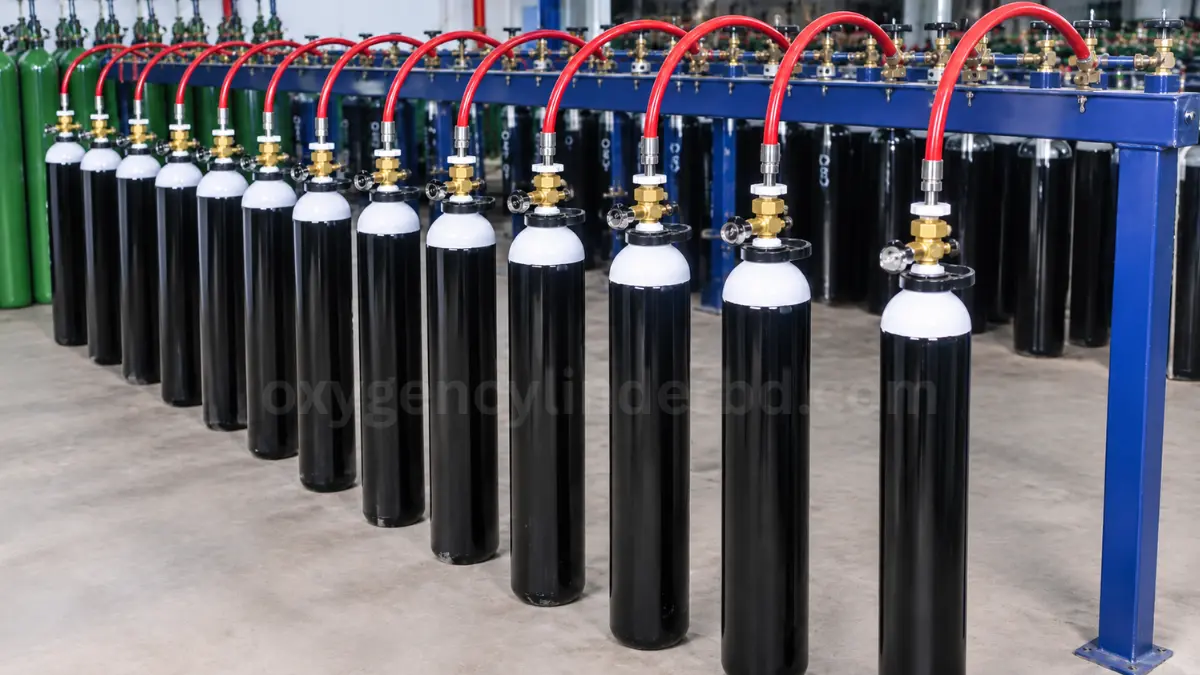
Only a trained team at a proper filling facility should refill cylinders. They have the right equipment, safety checks, and quality control.
What you can do at home is check the gauge, connect the regulator, and handle the cylinder safely. Leave the refilling to the experts.
Important Things to Check Before Refilling an Oxygen Cylinder
A safe refill starts before the oxygen goes in. Before you hand over your cylinder, check these points.
Check the Cylinder Itself
- Body: Look for rust, dents, cracks, or deep scratches.
- Valve: It should turn smoothly and not leak.
- Threads: They should be clean and not damaged.
- Label and markings: They should be clear and readable.
- Test date: Cylinders must be tested at set times. Make sure the date is still valid.
👉 Note: If the cylinder is damaged or out of test date, do not refill it. Ask the supplier about repair, testing, or replacement.
Check the Supplier's Process
- Do they inspect the cylinder before filling?
- Do they confirm the gas is medical oxygen?
- Do they use clean filling equipment?
- Do they seal or tag the cylinder after filling?
Check the Paperwork
- Ask for a bill with the date, size, and price.
- Ask for batch or fill details if they provide them.
- Keep the receipt for your records.
Remove and Check Your Accessories
Take off the regulator and flow meter before refilling. Check them for damage. Replace worn tubing, masks, or cannulas.
How Long Does It Take to Refill an Oxygen Cylinder?
The filling itself is often quick. But the whole process takes longer than most people expect.
Here is what adds time:
- Inspection: The supplier checks the cylinder first.
- Queue: Others may be waiting.
- Filling: The actual filling can take a short while, depending on the size and the plant.
- Checks: They check pressure and seal the cylinder.
- Travel: In Dhaka, traffic can add a lot of time.
| Step | What Happens |
|---|---|
| Call and order | You confirm size, time, and price |
| Pickup or drop-off | Cylinder goes to the filling place |
| Inspection | Cylinder is checked |
| Filling | Oxygen is filled under high pressure |
| Final check | Pressure is checked and the cylinder is sealed |
| Delivery | Cylinder returns to your home |
Overall time can range from under an hour to several hours. It depends on the supplier, your area, and the time of day. Always ask for an honest estimate. And never let your last cylinder run low while you wait.
💡 Tip: Use the swap method if your supplier offers it. They bring a full cylinder and take your empty one. This is often faster than waiting for your own cylinder to be refilled.
How to Identify a Properly Filled Medical Oxygen Cylinder
When the cylinder comes back, do not just accept it. Take a minute to check it.
Quick Checks
- Pressure gauge: Attach the regulator and open the valve slowly. The gauge should show a high reading, close to what the supplier says is full. A typical full pressure is around 2,000 PSI, but this can vary by cylinder type. Ask your supplier for the right number.
- Seal or tag: Many suppliers put a seal, cap, or tag on a freshly filled cylinder.
- Label: It should say medical oxygen and show the size, fill date, or batch details.
- Condition: The cylinder should be clean, with no rust, dents, or leaks.
- Valve and cap: The valve should work smoothly. The cap should be in place.
- No hissing: Listen for leaks around the valve and regulator.
About Colour Codes
Cylinder colours are not the same in every country. So do not depend on colour alone. Read the label and ask your supplier to confirm.
What a Good Fill Looks Like
| Check | Good Sign | Warning Sign |
|---|---|---|
| Gauge | High pressure, as expected for your cylinder | Low or unsteady reading |
| Label | Clear, says medical oxygen | Missing, faded, or unclear |
| Seal or tag | Intact | Broken or missing |
| Body | Clean and sound | Rust, dents, damage |
| Valve | Smooth, no leak | Stiff, hissing, or leaking |
| Bill | Given with details | No bill, no information |
👉 Note: If anything looks wrong, ask the supplier to fix it or replace the cylinder before they leave.
Why Does Your Oxygen Cylinder Run Out Faster Than Expected?
Many families notice that a cylinder lasts less time than they thought. Here are common reasons.
- A higher flow rate. The higher the setting, the faster the oxygen is used.
- Longer use than planned. More hours of use means less time left.
- Not fully filled. The cylinder may not have been filled to full pressure.
- A leak. A small leak at the valve, regulator, or tubing can drain oxygen.
- Loose connections. Poorly fitted parts can waste oxygen.
- Oxygen left running. If the tubing is not on the patient but the valve is open, oxygen keeps flowing.
- A faulty regulator or gauge. The gauge may read incorrectly.
- The wrong size cylinder. A small cylinder simply cannot last as long as a big one.
- Using the wrong math. Duration estimates change with pressure and cylinder type.
What to Do
- Check the gauge when the cylinder arrives.
- Check the flow setting. Never change it without medical advice.
- Look and listen for leaks.
- Turn the valve off when oxygen is not in use.
- Note how long each cylinder lasts. If it keeps running out too fast, tell your supplier.
- Ask whether a bigger cylinder would suit you better.
How to Store an Oxygen Cylinder Safely After Refilling
Once the cylinder is home, safe storage protects your family.
Do
- Keep it upright and secured with a stand, chain, or strap.
- Store it in a cool, dry, well-ventilated place.
- Keep it at a safe distance from flames, stoves, heaters, and sparks.
- Keep the valve cap on when it is not in use.
- Put "No smoking" or "Oxygen in use" signs nearby.
- Keep a fire extinguisher close.
- Keep full and empty cylinders apart, and label them.
- Keep it out of reach of children and pets.
Do Not
- Do not smoke near oxygen. Do not let others smoke either.
- Do not store it in direct sunlight or a hot room.
- Do not store it in a closed cupboard with no airflow.
- Do not put oil, grease, or petroleum jelly on the valve or regulator.
- Do not let it roll, fall, or get knocked over.
- Do not drag it. Use a cart.
Moving a Cylinder Safely
- Use a proper cart or trolley.
- Open windows if you carry it in a vehicle, and keep it secured.
- Never leave it in a hot, closed car.
- Never carry it by the valve.
Handy Storage Table
| Item | Right Way | Wrong Way |
|---|---|---|
| Position | Upright and secured | Lying down or loose |
| Place | Cool, dry, ventilated | Hot, damp, or closed |
| Distance from fire | Safely away | Near stove, candles, heaters |
| Valve | Cap on, closed when not used | Left open |
| Handling | Cart or stand | Dragging or rolling |
Why Should You Choose Medical-Grade Oxygen for Patient Care?
Not all oxygen is the same. Oxygen made for industry is not made for people. This is why you should always choose medical-grade oxygen for a patient.
What Makes Medical Oxygen Different?
- High purity. Medical oxygen is made to meet strict purity standards, usually above 99%.
- Clean process. It is filled using clean equipment and checked for quality.
- Safe for breathing. It is meant to go into the lungs of a patient.
- Clean cylinders. Cylinders for medical use are handled and prepared to keep the gas free from dirt and oil.
- Better tracking. Good suppliers keep records, labels, and batch details.
Why Industrial Oxygen Is Risky for Patients
- It may not meet breathing standards.
- It may be filled in cylinders that were used for other gases or that are not cleaned properly.
- There may be less quality control.
- It could carry dust, moisture, or other unwanted traces.
Patients with weak lungs, such as those with COPD, asthma, or post-infection breathing problems, are more sensitive. They deserve the cleanest and safest oxygen possible.
Quick Comparison
| Feature | Medical-Grade Oxygen | Non-Medical Oxygen |
|---|---|---|
| Made for | Patient breathing | Industrial use |
| Purity checks | Strict | Not made for patient care |
| Cylinder cleaning | Handled for medical use | May not be suitable |
| Labelling | Clear medical labelling | May not be clear |
| Safe for patients | Yes, when used as prescribed | Not recommended |
👉 Note: Always ask your supplier to confirm that your refill is medical grade.
Common Mistakes to Avoid When Refilling a Medical Oxygen Cylinder
Many people make the same errors. Here is how to avoid them.
- Waiting until the cylinder is empty. Always refill early.
- Choosing only the cheapest service. Low price can mean low safety.
- Not confirming medical-grade oxygen. Always ask.
- Trying to refill at home. This is dangerous. Leave it to professionals.
- Using a damaged cylinder. Rust, dents, and bad valves are red flags.
- Ignoring the test date. An out-of-date cylinder should not be refilled.
- Skipping the gauge check. Always check the pressure when it arrives.
- Not asking for a bill. A receipt protects you.
- Having only one supplier. Keep a backup number.
- Having only one cylinder. Keep a spare full cylinder if oxygen is needed daily.
- Ignoring traffic and timing. Plan for delays in Dhaka.
- Changing the flow rate yourself. Only a doctor should advise this.
- Poor storage after refill. Keep it upright, secured, and away from heat and flames.
Your Quick Refill Checklist
Use this list every time you refill.
- I called the supplier early, before the cylinder ran out.
- I confirmed the oxygen is medical grade.
- I checked the cylinder for damage and the test date.
- I removed and checked the regulator and accessories.
- I asked for an honest time estimate.
- I got a clear price and a bill.
- I checked the gauge when the cylinder came back.
- I checked the label, seal, and valve.
- I stored it upright, secured, and away from heat and flames.
- I saved the supplier's number and a backup number.
Final Thoughts
Finding the best oxygen cylinder refill service in Dhaka takes a little time. But it is worth it. A good supplier gives you safe, medical-grade oxygen, quick service, and peace of mind.
Here is a quick recap:
- Find your supplier before an emergency.
- Always confirm medical-grade oxygen.
- Check the licence, speed, delivery, and price.
- Never refill at home.
- Check the gauge, label, and seal on every refill.
- Store the cylinder upright, secured, and away from heat and flames.
- Keep a backup supplier and a spare cylinder.
When you plan ahead, you will never have to face that scary late-night moment unprepared.
Frequently Asked Questions (FAQs)
How do I find a good oxygen cylinder refill service in Dhaka?
Ask your doctor or hospital for trusted names. Then check for medical-grade oxygen, a valid licence, fast service, home delivery, and clear pricing. Keep a backup supplier too.
Can I refill an oxygen cylinder at home?
No. Refilling needs special equipment and trained people. Doing it at home is unsafe.
How often should I refill my oxygen cylinder?
It depends on cylinder size, flow rate, and hours of use. Refill when the gauge gets low. Do not wait until it is empty.
How long does a refill take?
It can take under an hour to several hours. Inspection, queues, filling, and Dhaka traffic all add time. Ask the supplier for an honest estimate.
How can I tell if a cylinder is properly filled?
Check that the gauge shows high pressure, the seal or tag is intact, and the label says medical oxygen. Also check for rust, dents, or leaks.
Why does my cylinder run out so fast?
Common causes are a high flow rate, long use, a leak, a loose connection, or a cylinder that was not fully filled. Check the gauge and listen for leaks.
Is medical-grade oxygen really necessary?
Yes. It is made for patient breathing and has strict purity and cleanliness standards. Industrial oxygen is not meant for patient care.
Should I keep a spare cylinder?
Yes, if oxygen is needed daily. A spare full cylinder protects you from delays, traffic, or supplier problems.
⚠️ Disclaimer: This article is for general information only. It is not medical advice. Please talk to your doctor or a qualified healthcare provider about your oxygen needs. Rules and licences can change, so confirm details with your supplier and the relevant authorities.